
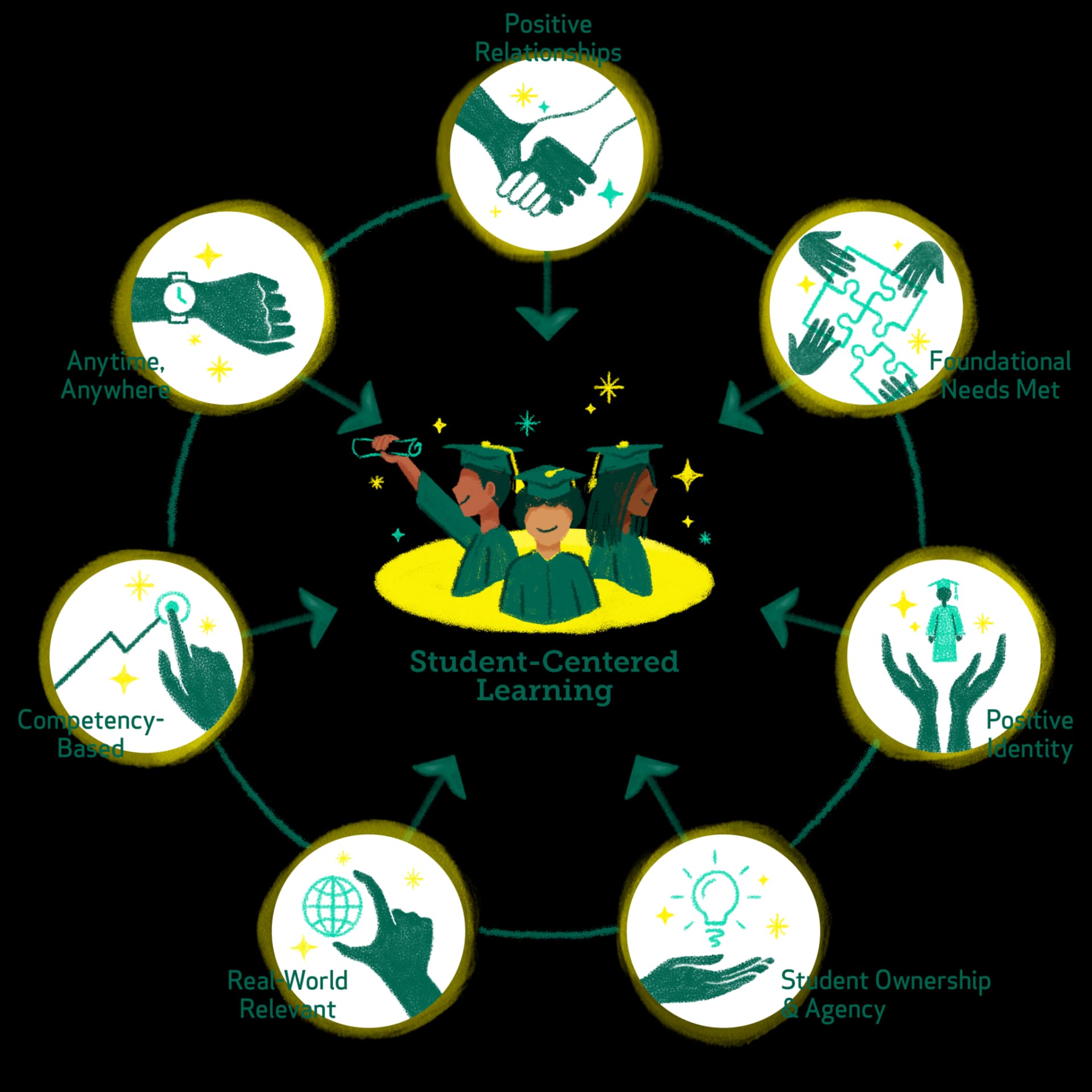
Seven principles of student-centered learning.
Researched and defined by our partners at Education Evolving. A common language, not a prescription — adapted by each school to fit its students, its place, its people.
Social Needs.
What every student needs in order to be in school and ready to learn.

Positive Relationships
Students have relationships with adults and peers who care about, believe in, and hold them to high expectations.
Read more
Foundational Needs Met
Students' physical, psychological, and safety needs are met.
Read more
Positive Identity
Students are fully embraced for who they are and develop a sense of positive identity and belonging.
Read moreEducation Experience.
What learning looks like — how and where students do the work.

Real-World Relevant
Students solve real-world problems and learn skills they will use in their own lives.
Read more
Competency-Based
Students advance by mastering clearly defined learning objectives, and receive support as needed.
Read more
Anytime, Anywhere Learning
Students learn in the community, at internships, on weekends, during extracurriculars.
Read moreStudent Agency.
How students take ownership over their own learning.
Every principle, read through an equity lens.
Education Evolving published a companion guide that maps equity considerations onto each of the seven principles. It's the clearest articulation of how learner-centered practice and anti-racist practice are the same practice — and how to translate that into the daily decisions inside a school.
Read the equity guide (PDF)When these principles are fully realized, the result is learning that is equitable, by design.Education Evolving, Equity in Student-Centered Learning Design (2022), p. 2.
See your school across all seven.
The Strength-Indicator tool reflects each principle back to your community — students, families, teachers, leaders. Use the picture to start conversations, not to keep score.